Queenby
 What Is Liquidation in Futures? Meaning, Mechanics, and How to Avoid It
Futures liquidation occurs when margin can no longer cover an open position. Learn the mechanics, how to calculate it, and strategies to avoid getting liquidated.
This article was put together with AI from the sources listed below and checked automatically. Something may be wrong or out of date. Report an error
Liquidation in futures is an automatic mechanism where an exchange closes a trader's position because the margin held is no longer sufficient to cover ongoing losses. If you're trading crypto futures—whether Bitcoin, Ethereum, or altcoins—understanding liquidation isn't optional. It's essential.
In simple terms: when price moves against your position far enough, the exchange immediately "cuts" the position before losses exceed the funds you've deposited. This process can happen in milliseconds, especially in fast-moving markets.
What Liquidation and Margin Mean in Futures
Margin in futures is the collateral deposited by traders to the exchange to guarantee an open position. Unlike stocks where you pay the full price of an asset, futures let you control a much larger position than the capital you actually put up. That's leverage.
The first standardized futures contracts traded on an exchange appeared at the Chicago Board of Trade (CBOT) in 1864, based on grain trading. From there, futures expanded into oil, currencies, stock indices, and eventually crypto assets. The Chicago Mercantile Exchange (CME) later launched the International Monetary Market (IMM) in 1972, the world's first financial futures exchange, starting with currency futures.
Two types of margin matter here:
Initial margin is the minimum amount required to open a position. For example, with 10x leverage, you only need $1,000 to control a contract worth $10,000. On crypto exchanges, initial margin is typically 1-10% of the contract value, depending on the asset's volatility.
Maintenance margin is the minimum balance that must remain in your account for the position to stay open. Usually around 50% of initial margin. If account equity drops below this level, a margin call is triggered—and if you don't top up quickly, liquidation follows.
In futures trading, both parties (long and short) deposit margin with the exchange as collateral. This was historically called a performance bond in US futures markets. The most common margin calculation methodology today is SPAN, which systematically assesses portfolio risk.
How Crypto Futures Liquidation Works
The mechanism starts the moment you open a position. Let's simulate:
- You deposit margin. Say $2,000 into a futures account with 20x leverage.
- Position opens. With 20x leverage, that $2,000 controls a position worth $40,000.
- Price moves against you. Every loss from the position directly eats into your margin.
- Equity falls to maintenance margin. At this point, you receive a margin call notification from the exchange.
- No action from trader. The exchange automatically liquidates your position.
- Position forcibly closed. Remaining margin (if any) returns to your account; the rest is gone.
The "marked to market" process runs daily—the exchange calculates position gains and losses daily, immediately moving funds from losing accounts to winning ones. In crypto markets operating 24/7, this runs in real-time. If the margin account falls below the exchange's threshold, a margin call is triggered. The trader must add funds or the position gets liquidated.
Liquidation Calculation Example
Consider a trader opening a long BTC/USDT position:
- Entry price: $60,000
- Leverage: 10x
- Deposited capital (initial margin): $500
- Maintenance margin ratio: 50% ($250)
With 10x leverage, the $500 margin should control a $5,000 position. Since BTC is priced at $60,000, the position size is roughly 0.0833 BTC.
Now calculate the liquidation price. If price drops to $57,000:
- Loss = 0.0833 × ($60,000 - $57,000) = $250
- Remaining margin = $500 - $250 = $250
At this point, equity has hit the maintenance margin ($250). If price drops even slightly further, liquidation occurs. The liquidation price is typically slightly above $57,000, accounting for the fee charged by the exchange.
Second example with higher leverage:
- Entry price: $60,000
- Leverage: 100x
- Capital: $100
- Buffer from entry to liquidation: roughly 0.99%
- Meaning: if BTC drops from $60,000 to $59,406, the position is immediately liquidated
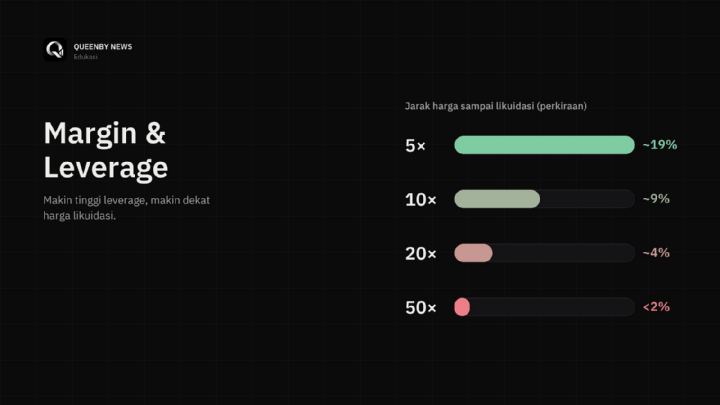
Higher leverage means a thinner buffer between entry price and liquidation price. With 10x, the buffer is about 10%. With 50x, it's only 2%. With 100x, it's under 1%.
Why Liquidation Matters for Traders
Liquidation isn't just about "big losses." There are several reasons futures traders need to understand this:
Extreme crypto volatility. Bitcoin can move 5-15% in a single day. With high leverage, one move is enough to wipe out positions.
High leverage on crypto exchanges. The US Federal Reserve caps stock market leverage at 2x (50% margin requirement) under Regulation T. Even in the 1920s, US brokers once allowed leverage up to 90% debt—when markets started falling, cascading margin calls caused forced selling that deepened the decline, contributing to the 1929 crash. Crypto exchanges allow leverage up to 125x, far exceeding traditional market limits.
Market cascade effects. Large-scale liquidations can worsen volatility. When positions are liquidated, exchanges sell assets forcibly at already-depressed market prices. This mass selling can push prices down further, triggering more liquidations—a phenomenon known as a liquidation cascade.
Hidden costs. Every liquidation typically incurs a fee from the exchange, ranging from 0.5-2% of initial margin. In sideways markets, these costs can erode capital faster than expected.
How to Monitor and Avoid Liquidation
Use stop losses. This is the most basic loss-limiting tool. Place stop losses below the liquidation price—not at the same level—because slippage can cause execution below the intended price.
Monitor liquidation heatmaps. Websites like Coinglass or Bybit provide liquidation heatmap data showing price levels where large liquidations are likely. This helps avoid opening positions right in the danger zone.
Watch funding rates in perpetual futures. The funding rate determines the payment or receipt occurring periodically between longs and shorts. Negative funding rate means shorts pay longs, usually a bearish signal. Extremely positive funding rates can indicate crowded speculative longs—which, when corrected, can trigger cascading liquidations.
Manage leverage wisely. Use leverage appropriate for your risk tolerance. Rough rule: with 10x leverage, the buffer is about 10% from entry. With 50x leverage, the buffer is only 2%. Higher leverage means a smaller buffer and faster liquidation when volatility strikes.
Monitor open positions regularly. Especially if you open a position and go to sleep or work. Use exchange alert features to know when price is approaching the liquidation level.
Understand open interest. Total open interest shows the number of contracts still open in the market. High open interest concentrated at one price level can become a liquidation magnet—the more positions clustered, the greater the potential for a liquidation cascade if price breaks through that level.
Watch for margin requirement changes. Exchanges can raise margin requirements suddenly when volatility rises (margin escalation). This can trigger unexpected liquidations. Monitor exchange announcements regularly.
Common Mistakes
Several errors traders frequently make, especially beginners:
- Using maximum leverage (100x) without careful calculation. Higher leverage means faster liquidation when volatility hits.
- Not placing stop losses. Hoping price "will definitely bounce" without a loss limit. That's gambling, not strategy.
- Ignoring margin calls. Treating margin calls as non-urgent, even though the window to add funds is often quite short.
- Depositing too little relative to position size. Initial margin that's too thin makes the liquidation distance extremely short.
- Not calculating liquidation costs upfront. Liquidation fees can be substantial and worsen losses.
- Overconfidence after small profits with high leverage. A 5% profit with 50x leverage is enticing, but total capital loss is just as easy.
Risks and Limitations
Liquidation doesn't always execute at the calculated liquidation price. Slippage can occur, especially in thin markets or during extreme volatility. Actual execution price can be far below the liquidation price.
In extreme market conditions (flash crashes), you can lose more than your deposit. Negative balance can occur if the market drops too fast before the position is sold. Some exchanges offer protection, but not all.
Margin requirements can change. Exchanges can raise margin requirements suddenly, especially when volatility rises. This can trigger unexpected liquidations.
Historical backtesting doesn't guarantee future results. Past liquidation levels aren't always relevant to current market conditions.
Related Terms
| Term | Brief Meaning |
|---|---|
| Initial Margin | Initial deposit to open a futures position |
| Maintenance Margin | Minimum balance required to keep a position open |
| Margin Call | Warning that account equity is approaching minimum threshold |
| Liquidation Price | Price at which a position is automatically closed |
| Leverage | Capital multiplier; 10x means control 10x the capital |
| Long Position | Speculation that price will rise |
| Short Position | Speculation that price will fall |
| Funding Rate | Periodic payment between longs and shorts in perpetual futures |
| Open Interest | Total open contracts in the market |
| Mark Price | Reference price used to calculate unrealized PnL and liquidation |
| Cross Margin vs Isolated Margin | Cross: margin shared across positions; Isolated: margin per position is capped |
FAQ
What's the difference between liquidation and a margin call?
A margin call is a warning that your account equity is approaching the minimum threshold. You still have time to deposit more funds or add collateral. Liquidation occurs when equity can no longer cover the position, and the exchange automatically closes it.
Why does liquidation happen more often in crypto than stocks?
Crypto markets are notoriously volatile with large price swings in short timeframes. Leverage on crypto exchanges is also often much higher—ranging from 10x to 125x—so even a small price move against your position can trigger liquidation.
What is a liquidation price?
The liquidation price is the specific price level at which your position will be automatically closed by the exchange. It's calculated based on the leverage used, entry price, and maintenance margin requirement.
Can I lose more than my initial margin in liquidation?
On most regulated exchanges, your maximum loss is limited to the margin you deposited. However, in some exchanges or extreme market conditions (rapid crashes), slippage can cause liquidation below the expected price, resulting in negative balance.
Is liquidation the same as forced selling?
Conceptually similar—both are forced sales. Liquidation applies to futures when margin runs out, while forced selling typically refers to selling real assets (stocks, property) due to compulsion from a bank or court.
What are perpetual futures and how do they relate to liquidation?
Perpetual futures are futures contracts without expiry dates, common on crypto exchanges. A funding rate mechanism keeps prices from straying too far from spot. Positions can stay open indefinitely as long as margin holds.
How do I check estimated liquidation price before opening a position?
Most exchanges provide a margin calculator on their platform. Traders input entry price, leverage, and position size to see the liquidation price and required margin.
Sources
This article is for education only. It is not financial advice or a recommendation to buy or sell any asset. Futures trading is high risk. See also our Terms & Conditions.