Queenby
 Margin and Leverage: Sizing Positions So Your Account Survives
Margin, leverage and the distance to liquidation explained with real numbers, plus a few simple habits that keep a futures account alive longer.
Most futures accounts that blow up don't do it because of one bad call. They do it because the position was too big for the balance behind it. Setting margin and leverage deliberately means one mistake doesn't turn into a disaster.
Margin vs leverage
- Position value (notional) is the size of your position in the market.
- Leverage is the multiplier.
- Margin is the money locked up for that position: the position value divided by the leverage.
Example: a $400 position at 20× needs $20 of margin. The same position at 10× needs $40.
How close is liquidation?
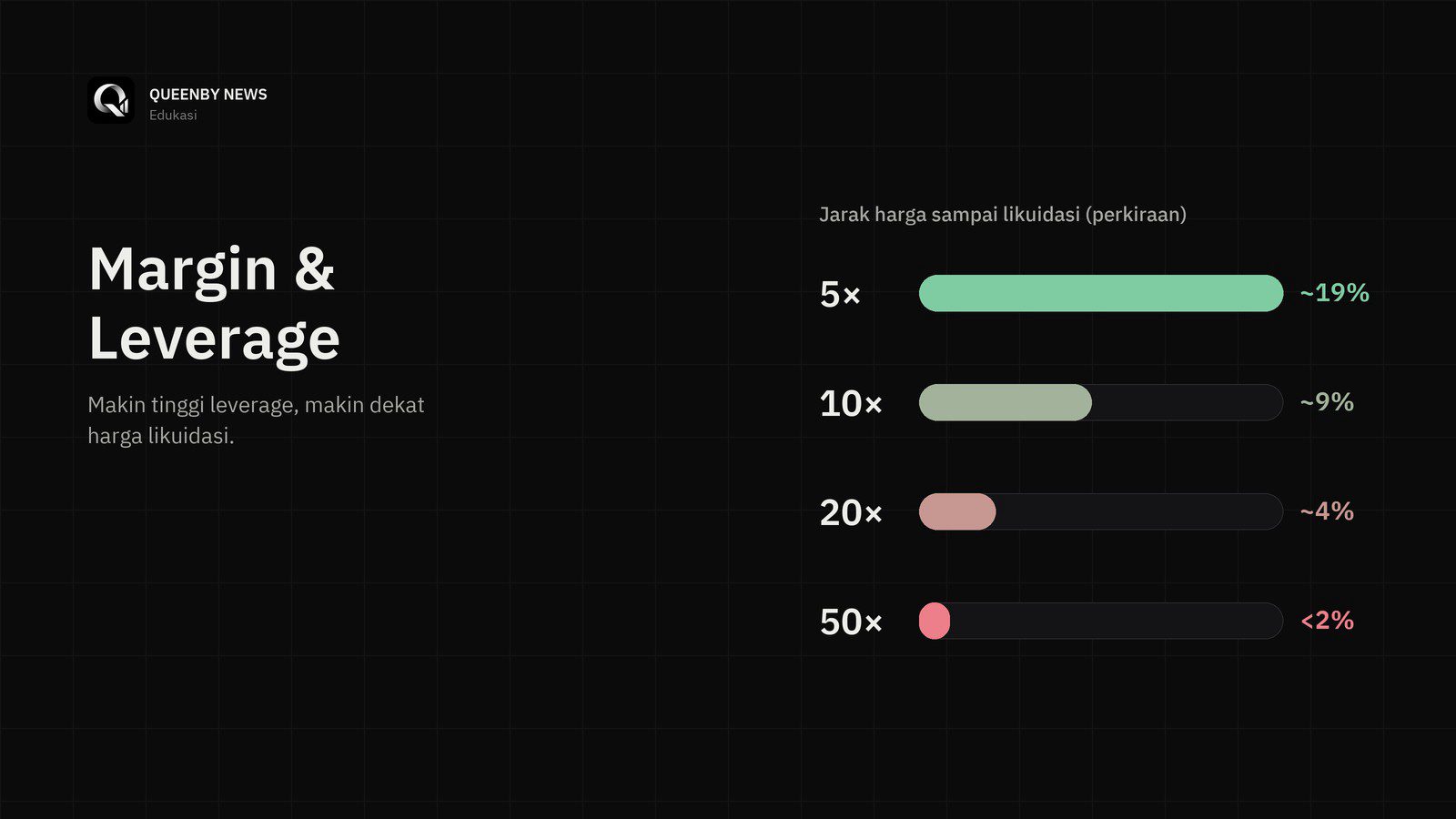
The higher the leverage, the closer the liquidation price. Roughly, on isolated margin:
| Leverage | Adverse move until liquidation (approx.) |
|---|---|
| 5× | about 19% |
| 10× | about 9% |
| 20× | about 4% |
| 50× | under 2% |
The exact figure depends on each coin's maintenance margin and fees, so always check the liquidation price Binance shows before you enter.
Cross or isolated
- Isolated: each position has its own margin. If one position is liquidated, you only lose that position's margin.
- Cross: all positions share the balance. A losing position can "borrow" from the balance, so liquidation is further away, but one position going bad can drag the rest down with it.
Habits that keep an account alive
- Keep margin per position small relative to the balance. Many traders use 1 to 5% of their balance as margin per position.
- Limit how many positions run at once. Ten small positions in the same direction can still all lose together when the market drops.
- Don't commit the whole balance. Leave room for drawdowns and funding.
- Use a stop-loss. Decide where you'll get out before you get in.
At Queenby
In the dashboard, Size per trade sets three things: margin per position (in dollars or as a percentage of available balance), leverage, and the maximum number of positions open at once. Every trade copied to your account uses those numbers. You stay in control and can change them any time.
This article is for education, not financial advice. Set things up to suit your own situation and risk tolerance.
This article is for education only. It is not financial advice or a recommendation to buy or sell any asset. Futures trading is high risk. See also our Terms & Conditions.