Queenby
 Partial Closes: Why Your Balance Rises While the Position Is Still Open
Closing part of a position books that profit into your balance right away, while the rest keeps running. Here's how it works and how we record it.
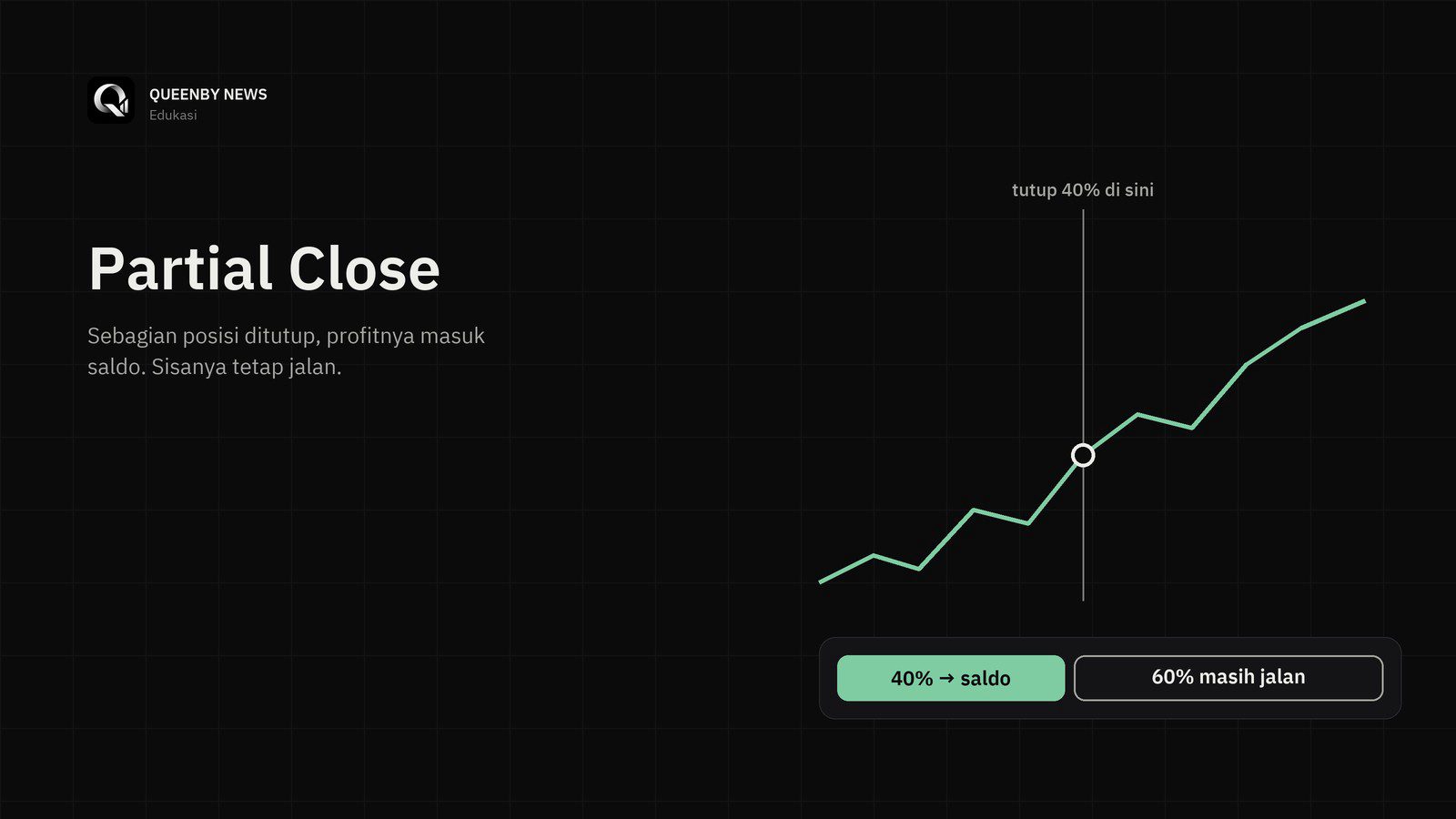
Ever seen your balance go up while the position is still open? That's usually a partial close: part of the position is closed early and the rest is left to run.
How a partial close works
Say you're long 1,000 coins and the price has moved up. You close 400 of them first. Here's what happens:
- The profit on those 400 coins is realized immediately and added to your wallet balance.
- Commission is charged only on the part you closed.
- The remaining 600 coins stay open at the same entry price. A partial close doesn't change your average entry.
That's why the balance rises first while the position is still on your screen.
Why traders like partial closes
- They lock in part of the profit. If the price turns, what you've already taken doesn't disappear with it.
- They cut risk. The position gets smaller, so if the stop is hit, the loss is smaller too.
- They give the rest room to run. The remaining part can ride the trend for longer.
There's another side: if the price keeps climbing, the total profit ends up smaller than if you'd held the full position. A partial close is a balancing act, not a sure-fire win.
How we record it
At Queenby, a partial close is recorded as balance activity at its net value (profit minus commission). The net figures on the landing page and in the journal already include profit from partial closes on positions that are still open.
Once the position is fully closed, every part closed earlier is folded into a single trade. That trade's PnL covers all of it, so nothing is counted twice. In the trade history, trades like this are marked "partial close".
This article is for education only. It is not financial advice or a recommendation to buy or sell any asset. Futures trading is high risk. See also our Terms & Conditions.